


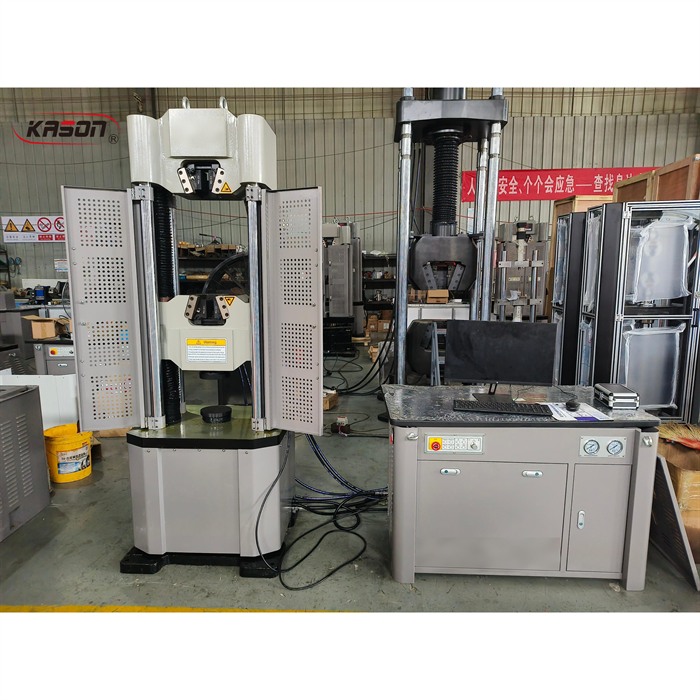
KASON HUT605Wis a servo Hydraulic universal testing machine in theservo hydraulic universal testing machinerange. It covers the Tests that a metals laboratory, a rebar fabricator and a fastener plant all need from one frame: tension, compression, bending and shear on metallic and non-metallic materials. The hydraulic wedge grips close on the specimen automatically, a six column frame carries the reaction, and the controller holds force, deformation and displacement in closed loop.
Key Takeaways
- One frame covers tension, compression, bending and shearing, so a metals laboratory does not need a separate machine for each test type.
- The frame is built from four columns plus two screws, which raises rigidity and keeps the load axis straight between the grips.
- Hydraulic wedge grips clamp the specimen automatically and open from the front, so a heavy plate or a rebar specimen is positioned quickly and safely.
- Force, deformation and displacement are all held in closed loop, and the operator can run displacement, force, deformation, stress or strain control without changing machines.
- A hand-held controller lets the operator raise or lower the beams and clamp or release the jaws from beside the specimen.
What the HUT605W Is Built For
The machine is aimed at metals and at the materials that metals are used with. On the metal side it covers wire, rod, tube, strip, plate and sheet, tested in tension, compression, bending and shear. On the fastener side it covers bolts, studs and nuts in tensile, proof load and single or double shear tests. On the construction side it takes reinforcing bar, wire, mesh and folded sections, together with compression tests on concrete cubes and components. Non-metallic specimens are accepted as well, which makes the frame useful to a mixed materials laboratory rather than only to a steel mill.
Six Columns, Not Four: What the Frame Buys You
A frame that carries a heavy load can fail a test in two ways: the specimen breaks, or the frame bends and the measurement drifts. The HUT605W addresses the second problem structurally. The main frame is built from four columns and two screws, a configuration that raises stiffness, shares the load across the structure and keeps the axis of the load straight between the grips. The result is a large vertical clearance between the grips, so long specimens and long extensions can be tested without changing the frame. A double-acting crossbeam travels quickly to accommodate specimens of very different lengths, and a mobile crossbeam lets the Testing space be adapted to the sample rather than the sample to the space. A rigid metal cover is available for laboratories that want the operators separated from the load train.
Hydraulic Wedge Grips and the Hand-Held Controller
The tensile grips are built-in wedge type hydraulic clamps that close automatically on the specimen and hold it with a force proportional to the pull, so a specimen that grips harder as the load rises cannot slip. They open from the front, which is what makes loading a heavy plate or a rebar specimen practical rather than a two person job, and the grip sets cover both round and flat specimens. Because the gripping and the beam movement can both be driven from the hand-held controller, the operator can stand beside the specimen while it is positioned, with the machine under control the whole time. Compression Platens fit under the crossbeam for cube and cylinder work, and bending, shear, chain, welded fabric and four point bending attachments extend the same frame to the rest of a metals test list.
Three Closed Loops, One Test
The control system is built around a controller that closes the loop on force, deformation and displacement at the same time. That combination is what allows a test to be run in force control while the deformation is measured, or in displacement control while the force is watched, and to switch between them smoothly as the specimen yields. Available modes include displacement, force, deformation, stress and strain control, together with constant stress and constant strain. An electronic Extensometer measures elongation directly on the gauge length, a spoke type Load Cell sits under the test space and is verified against the international force verification standard, and a digital displacement sensor reports crossbeam position. The software adjusts the zero point and gain digitally for all three channels, stores and loads parameter sets so one frame can be re-tasked quickly, and plots the reference curve while the loop is being tuned so the operator can see the effect of a setting. Curve handling covers re-appearance, amplification, reduction, self-adaptation and lapping, with display and printing of any range and read-out of the coordinates of a test point. Multi level identity management separates what an ordinary operator can do from what a supervisor can change, load can be displayed in kN, lbf or kgf, and an optional camera module records the whole test so that a disputed result can be replayed rather than argued about.
Standards and Applications Covered
The three standards below are the ones most often named when a metals laboratory specifies a Universal Testing Machine, and each of them is served directly by the frame and the control modes described above:
- ISO 6892-1, metallic materials, tensile testing at room temperature, the international method for the tensile properties of metals
- ASTM E8/E8M, the North American test methods for tension testing of metallic materials
- ISO 15630-1, steel for the reinforcement and prestressing of concrete, test methods for reinforcing bars, rods and wire
The measurement and control software carries a library of pre-built test applications covering the GB, ASTM, DIN, JIS and BS families, so a laboratory that works to more than one national system can select the method rather than build it. Because the load, deformation and displacement channels are all closed loop and traceable, results can support incoming inspection, batch release and third-party reports rather than only in-house screening.
Frequently Asked Questions
1. Can one machine really cover rebar, plate and fasteners?
Yes, with the right tooling. The frame supplies tension, compression, bending and shear testing spaces, and the standard and optional attachment range covers round and flat tensile specimens, compression platens, bending rollers, shear fixtures, fastener grips for bolts, studs and nuts, chain grips and welded fabric grips.
2. How are heavy specimens handled?
The hydraulic wedge grips clamp automatically and open from the front, so the specimen is placed rather than wrestled into position, and the hand-held controller drives the crossbeam and the jaws from beside the test space. That combination is what makes plate and rebar work safe for a single operator.
3. What happens if the load cell or displacement reading drifts?
The software allows digital adjustment of the zero point and gain on the load, deformation and displacement channels, and the controller shows the reference curve while the closed loop parameters are being set, so the effect of a change is visible immediately. The load cell is verified against the international force verification standard.
4. Can the machine be adapted to a different test programme later?
Yes. The attachment range can be extended with compression, bending, shear, chain, fastener and four point bending grips, and the software accepts new test schemes without replacing the controller. Units can be switched between kN, lbf and kgf for operators who work in different systems.
5. Where does the HUT605W sit in the KASON range?
Alongside the larger servo hydraulic frames for heavier sections, theelectronic universal testing machinesfor lower force work on plastics, films and components, and theconcrete compression test machinesfor construction materials.
Contact me if you are interested!
Email: admin@jnkason.com
Whatsapp: +86 15910081986